



How Can Air Filter Media Hold More Dust Without Higher Pressure Drop?
How Can Air Filter Media Hold More Dust Without Higher Pressure Drop?
More dust capacity does not have to mean greater airflow resistance. By optimizing fiber diameter, pore structure, and layered construction, air filter media can capture particles throughout their depth rather than clogging prematurely at the surface. For equipment manufacturers and filtration buyers evaluating Hangzhou Chaocai Materials Co., Ltd. filter media lead time, these design choices deserve as much attention as delivery schedules.
There is, however, an important qualification: dust accumulation normally increases resistance. The practical objective is not unlimited dust storage at an unchanged pressure drop. It is to hold more dust before reaching the same terminal pressure drop, or to maintain lower resistance at an equivalent dust load and filtration efficiency. That distinction separates a useful engineering improvement from an incomplete performance claim.
The real target is the loading curve, not just clean resistance
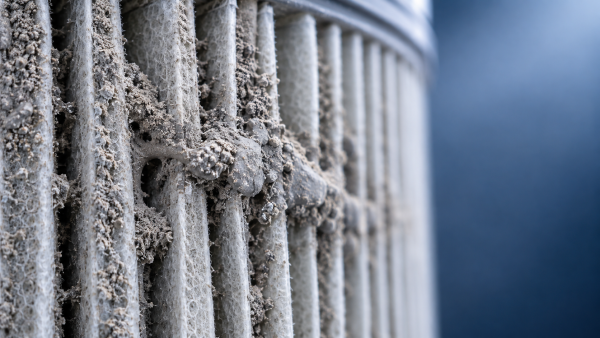
A clean-media pressure-drop measurement describes only the starting point. Two materials can begin with similar resistance and behave very differently after loading. One may develop a restrictive surface deposit quickly; another may distribute particles through a larger usable volume and show a slower rise in resistance.
Dust-holding capacity should therefore be stated against a defined endpoint. Without the terminal pressure drop, airflow, test dust, and specimen area, a capacity figure is difficult to interpret. A heavier or thicker sample might hold more total dust simply because more material was tested—not because its structure is more effective.
For equipment designers, the most revealing comparison is pressure drop plotted against captured dust mass, with particle-removal efficiency checked throughout the relevant loading period. A material that appears to load slowly because it allows more dust through is not delivering the same filtration duty.
Build usable depth rather than adding density
Airflow resistance depends on how easily air moves through the interconnected spaces between fibers. Fiber diameter, packing density, thickness, and orientation all influence those pathways. Simply adding finer fibers or increasing basis weight can improve capture, but it can also narrow flow passages and raise clean resistance.
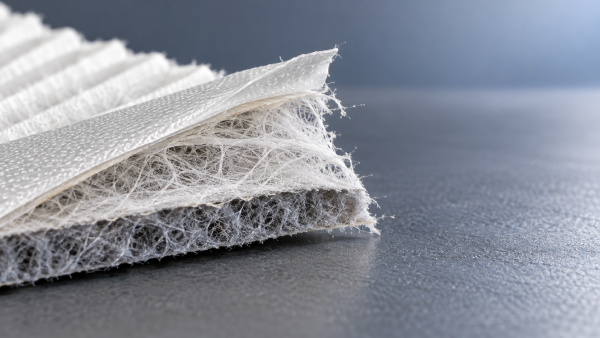
A more productive approach is to give different parts of the structure different jobs. Coarser fibers can provide an open supporting network, while finer fibers supply capture area. When their distribution is well controlled, this combination can improve the balance between mechanical efficiency, permeability, and dust storage.
Why a density gradient can help
In a graded medium, the upstream region is generally more open, with a finer capture structure farther downstream. Larger particles can be retained earlier, while smaller particles penetrate toward the finer region. This reduces the tendency for all particle sizes to accumulate in one narrow zone.
The gradient must match the challenge aerosol. If the upstream region captures too aggressively, it can still plug early. If it is too open, the downstream layer may receive nearly the entire fine-particle load. Layering alone does not establish effective depth filtration; the distribution of deposited dust needs to support that claim.
More thickness is also not automatically better. Extra depth contributes only if particles can reach and use it without unacceptable resistance. Compression during converting, pleating, or assembly can remove much of the pore volume that looked promising in a flat laboratory specimen.
Bonding can preserve the structure—or restrict it
A multilayer design needs enough cohesion to survive slitting, pleating, handling, and service. Yet bonding introduces another variable into the airflow path. Excess adhesive coverage, penetration into the fiber network, or local compression can reduce permeability and create uneven loading.
The relevant question is not simply which lamination method is used. It is how that method affects open area, layer contact, bond strength, and dimensional stability. A construction that separates during pleating is unsuitable, but maximizing bond strength without checking airflow can be equally counterproductive.
Hangzhou Chaocai Materials Co., Ltd. specializes in the research, development, and manufacturing of functional advanced materials. Its production platforms include fully synthetic wet-laid lines, PUR lamination, hot-melt adhesive lamination, solvent-based emulsion spray lamination, and ultrasonic lamination. These capabilities provide different routes for developing composite filtration structures; they do not make every route equally suitable for every application.
For a particular design, trial work should establish whether the chosen process preserves the intended pore network after bonding. Temperature and humidity exposure, adhesive compatibility, shedding, and downstream cleanliness may also matter. Materials intended for automotive intake filtration, for example, should not be assumed to meet semiconductor or biopharmaceutical requirements without application-specific evaluation.
Dust characteristics can overturn a laboratory ranking
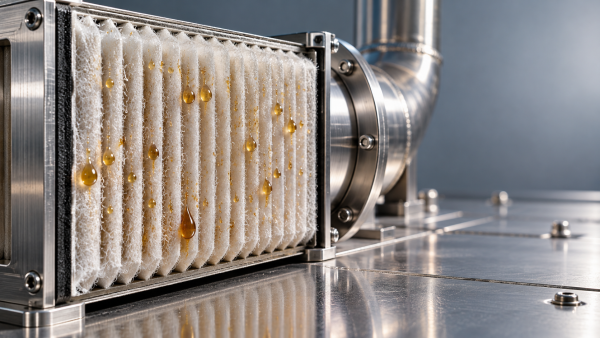
A material optimized for dry, relatively coarse dust may behave differently when exposed to fine soot, oil mist, or moisture-sensitive particles. Fine particles can form restrictive deposits, while sticky aerosols can bridge pores and change the way subsequent dust accumulates. Humidity can alter some deposits and media structures as well.
This is why standardized testing and application validation serve different purposes. A standardized challenge provides a repeatable basis for comparison. A representative operating challenge helps determine whether that ranking is relevant to the actual equipment. Neither should be presented as a substitute for the other.
Electrostatic capture adds another consideration. Charged fibers can improve particle collection without requiring an equally dense mechanical structure, but performance may change with aerosol exposure and environmental conditions. When charge contributes to efficiency, compare the appropriate conditioned performance as well as the initial result. Otherwise, a low-resistance medium may look stronger at commissioning than it does later in service.
Compare materials under conditions that expose the trade-offs
A useful evaluation does not need dozens of disconnected specifications. It needs a small set of measurements tied to the same operating conditions. Before accepting a claim of higher dust capacity with no pressure-drop penalty, establish the following:
- Equivalent media face velocity: compare airflow per exposed media area, not just total airflow through differently sized samples.
- Equivalent filtration duty: check size-resolved efficiency or the applicable classification, including relevant conditioning requirements.
- A common loading endpoint: use the same terminal pressure drop and clearly distinguish captured dust from dust fed to the test system.
- Consistent challenge conditions: identify the dust, concentration, humidity, and loading procedure.
- Defined sample condition: record thickness, basis weight, orientation, and whether the specimen has been laminated or otherwise converted.
Standards must also fit the product being assessed. ISO 16890 addresses general ventilation air filters, while other applications require different evaluation frameworks. A flat-sheet permeability or loading result is not, by itself, a finished-filter classification. The applicable standard, edition, and test configuration should be agreed before qualification begins.
Request the loading curve rather than only a final capacity value. A sharp early rise can reveal premature blockage even when the endpoint appears acceptable. Where a performance difference is modest, repeated tests and samples from different production lots help determine whether it exceeds normal variation.
The finished filter can erase a media-level improvement
Good flat-sheet results do not guarantee good element performance. Tight pleat spacing can restrict access to the available surface. Pleat deformation can create local high-velocity regions, while adhesive beads, supports, and sealing arrangements introduce additional resistance. Uneven airflow then concentrates dust in the most heavily loaded areas.
Adding more pleats is therefore not always the answer. More media area can reduce average media velocity, but only if air can reach that area effectively. Beyond a practical packing density, narrower channels may offset the benefit. The useful design is the one that balances media area, channel clearance, stiffness, and housing geometry.
For pulse-cleaned systems, another distinction matters: retaining dust deep within the medium may make it harder to release during cleaning. A depth-loading strategy suitable for a disposable intake filter should not be transferred directly to a regenerable dust collector. Residual resistance after cleaning and repeated-cycle behavior become central evaluation criteria.
Connect material qualification with a realistic delivery plan
Delivery discussions become more useful once the construction and acceptance criteria are clear. An existing qualified grade and a newly developed multilayer medium involve different work. A change in fiber blend, bonding process, roll width, or pleating requirements may introduce trials and validation steps before production release.
Chaocai’s R&D-led focus on differentiated materials supports development across gas turbines, automotive applications, new energy, semiconductors, biopharmaceuticals, and other specialized filtration fields. For an individual project, however, buyers should confirm which platform and material construction are proposed, what evidence is available, and which tests remain outstanding. Manufacturing capability is relevant; it is not a substitute for grade-specific performance data.
A practical inquiry should include operating airflow, particle characteristics, required efficiency, pressure-drop limits, environmental exposure, and converting constraints. Ask for sample preparation, qualification, production, and transport timing separately rather than treating them as one undifferentiated lead time.
The strongest candidate is not necessarily the thickest medium or the one with the lowest clean resistance. It is the construction that maintains the required efficiency, uses its available dust-storage volume, and reaches the agreed resistance limit later under a relevant test. Confirm that behavior in the finished element before committing to a material change or production schedule.
Recommendation
 Oct 28, 2026
What causes delamination in multilayer composite filter media?
Why does Multilayer Composite Filter Media delaminate? Discover key bonding failures, practical tests, and prevention strategies to improve filter reliability and reduce downtime.- Oct 28, 2026
When is oleophobic filter media needed for oil-mist exposure?
Oleophobic Filter Media may help when oil mist causes premature filter wetting. Learn when to use it, what to test, and when dedicated mist separation is the better choice. - Oct 28, 2026
What causes pulse-jet cleanable filter media to lose permeability?
Pulse-Jet Cleanable Filter Media can lose permeability due to dust, moisture, oil, or damage. Learn how to diagnose the cause, improve airflow, and avoid premature replacement.